
Electric vehicles have changed the way people think about performance, efficiency, and long-distance driving. Instead of engines and gears, everything now depends on software, battery management, and how power is delivered to the wheels. One of the most common questions among new EV buyers is: do the driving modes in Cadillac Lyriq offer different ranges or battery usages?
The Cadillac Lyriq is a luxury electric SUV built around GM’s Ultium battery platform, designed to balance performance with efficiency. Like most modern EVs, it offers multiple driving modes that change how the vehicle behaves. But the real question is whether those modes actually change how far you can drive or how fast the battery drains.
To understand this properly, we need to look beyond simple mode names and focus on how energy is managed inside the vehicle.
Understanding Driving Modes in Cadillac Lyriq
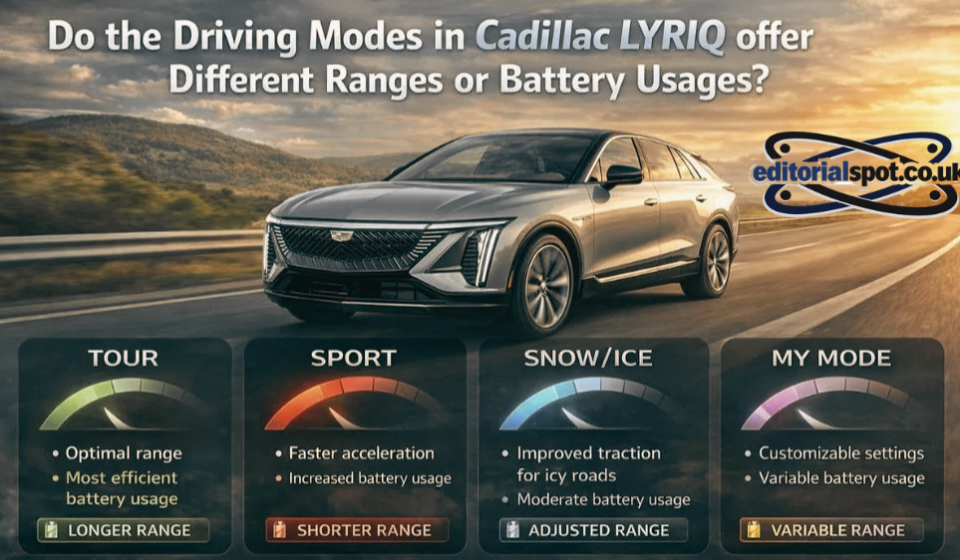
The Cadillac Lyriq includes driving modes such as Tour, Sport, and Snow/Ice, each designed for different road conditions and driving preferences. These modes do not change the physical battery capacity, but they do change how the vehicle uses that battery in real time.
In simple terms, driving modes act like software profiles. They adjust throttle response, power delivery, traction control, and regenerative braking behavior. This is why the driving experience feels different in each mode even though the battery remains the same.
According to GM’s EV platform design approach, most energy optimization happens through software calibration rather than mechanical changes. That means efficiency differences come from how electricity is used, not how much is stored.
So when we ask do the driving modes in Cadillac Lyriq offer different ranges or battery usages, the correct understanding is that they influence consumption patterns, not battery size.
Tour Mode and Real-World Efficiency Behavior
Tour Mode is the default setting in the Cadillac Lyriq, and it is designed for everyday driving conditions. It offers a balanced combination of comfort and efficiency, making it the most energy-conscious option in most situations.
In Tour Mode, the accelerator response is smooth and predictable. The vehicle does not deliver sudden bursts of torque unless required. This controlled power delivery helps reduce unnecessary energy spikes, which directly supports better range.
Regenerative braking is also tuned for balanced recovery, meaning the vehicle tries to recapture energy without making the driving experience too aggressive or jerky.
In real-world conditions, Tour Mode typically delivers the most stable and predictable range estimates. However, even in this mode, external factors such as speed, weather, and terrain still play a major role in determining actual distance.
Industry EV testing sources such as the U.S. Department of Energy’s EV research programs consistently show that steady driving at moderate speeds has a larger impact on efficiency than any driving mode selection alone.
Sport Mode and Energy Consumption Dynamics
Sport Mode in the Cadillac Lyriq is designed to enhance performance rather than efficiency. It sharpens throttle response and makes acceleration more immediate. This gives the vehicle a more responsive and dynamic feel, especially during highway merging or overtaking.
However, this responsiveness comes at a cost. The system allows more power to flow from the battery to the motors more quickly, which increases energy consumption. Even small changes in acceleration behavior can have a noticeable effect on range over time.
In Sport Mode, drivers tend to accelerate more aggressively, which compounds the energy usage effect. The battery drains faster not because the system is inefficient, but because it is intentionally designed to prioritize performance.
Real-world EV studies show that aggressive driving patterns can reduce range significantly regardless of vehicle model. This means Sport Mode naturally leads to higher consumption even if the battery itself is unchanged.
So, in the context of do the driving modes in Cadillac Lyriq offer different ranges or battery usages, Sport Mode represents the upper end of energy demand.
Snow and Ice Mode for Stability Over Efficiency
Snow and Ice Mode is primarily focused on safety. It adjusts traction control, torque distribution, and throttle sensitivity to help the vehicle maintain stability on slippery surfaces.
This mode does not aim to maximize range. Instead, it reduces wheel slip and prevents sudden power surges that could cause loss of control.
Because traction systems engage more actively in low-grip conditions, energy usage can vary depending on the surface. On snow, ice, or wet roads, the system may consume slightly more energy to maintain stability. However, this is situational rather than a fixed efficiency penalty.
It is important to understand that Snow/Ice Mode is not designed for energy optimization. Its priority is control and safety, especially in unpredictable driving environments.
How Driving Modes Actually Affect Battery Usage
To fully answer the question do the driving modes in Cadillac Lyriq offer different ranges or battery usages, we need to separate perception from technical reality.
The battery in the Cadillac Lyriq has a fixed capacity, and driving modes do not increase or decrease that capacity. What changes is how quickly energy is drawn from it.
Driving modes influence three major factors:
- Throttle sensitivity, which affects acceleration energy spikes
- Regenerative braking behavior, which affects energy recovery
- Power distribution strategy, which determines how aggressively motors respond
These adjustments create differences in efficiency, but they do not create separate “battery ranges” in a strict technical sense.
The EPA-estimated range for the Cadillac Lyriq remains consistent under standardized testing conditions, but real-world range varies based on driving behavior, not just mode selection.
Why Driving Style Matters More Than Driving Mode
One of the most overlooked aspects of EV efficiency is driver behavior. Even the most efficient mode cannot compensate for aggressive driving habits.
Sudden acceleration requires large bursts of energy. High-speed driving increases aerodynamic resistance, which forces the motor to work harder. Frequent braking without regenerative recovery wastes potential energy.
In comparison, smooth acceleration and consistent speed significantly improve range, regardless of whether the vehicle is in Tour or Sport Mode.
This is supported by multiple EV efficiency studies, including research from the U.S. Department of Energy, which highlights driving behavior as one of the most significant factors affecting electric vehicle range.
So while driving modes matter, they are only part of the equation.
Regenerative Braking Energy Recovery
Regenerative braking is one of the key technologies that influences EV efficiency. In the Cadillac Lyriq, this system converts kinetic energy back into electrical energy during deceleration.
When drivers lift their foot off the accelerator or use one-pedal driving, the system slows the vehicle while recovering energy into the battery.
This feature is especially useful in city driving where frequent stops occur. It helps extend range by reducing wasted energy.
While driving modes may slightly adjust regenerative braking strength, the biggest factor remains driver input. Smooth and anticipatory driving results in better energy recovery than relying on mode settings alone.
Real-World Driving Conditions and Their Impact
In real-world use, several environmental factors have a greater effect on range than driving modes:
Cold weather reduces battery efficiency because chemical reactions inside the battery slow down. Heat increases cooling demand, which also consumes energy. Highway speeds increase aerodynamic drag, which is one of the biggest energy drains for any EV.
Even terrain plays a role. Uphill driving requires more energy, while downhill sections allow partial recovery through regenerative braking.
This is why two drivers using the same mode in different environments can experience very diffe
Practical Understanding of Range Differences
When people ask do the driving modes in Cadillac Lyriq offer different ranges or battery usages, they are usually looking for a simple yes or no answer. But the reality is more nuanced.
Yes, driving modes influence energy consumption. However, they do not directly change battery capacity or official range ratings.
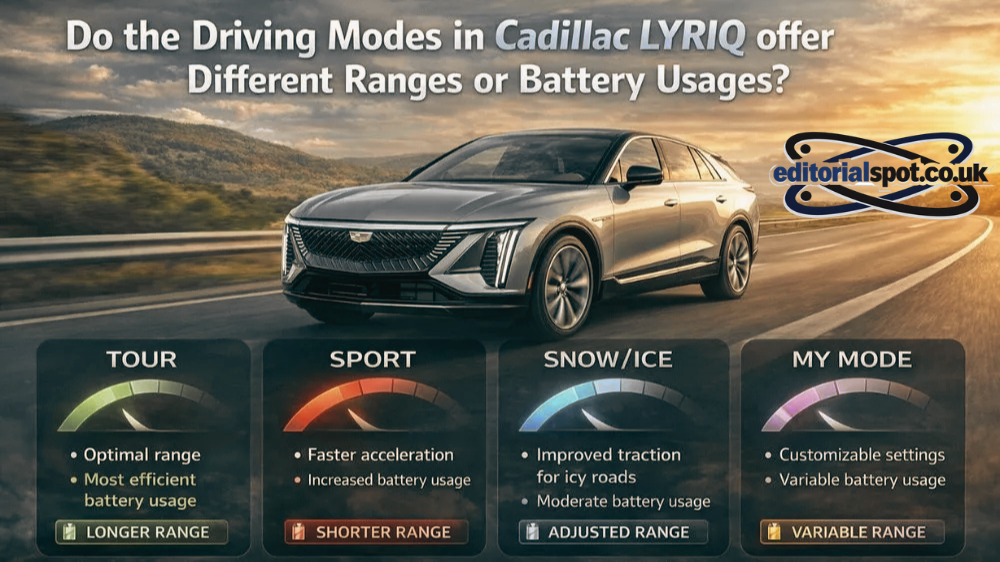
Tour Mode generally provides the best balance for efficiency. Sport Mode increases consumption due to performance tuning. Snow/Ice Mode prioritizes safety and traction over efficiency.
But none of these modes operate independently of driver behavior or environmental conditions.
How to Maximize Cadillac Lyriq Range in Daily Driving
To get the most out of the Lyriq’s battery, a combination of smart driving habits and correct mode selection is essential.
Using Tour Mode during daily commuting helps maintain balanced efficiency. Keeping acceleration smooth and avoiding unnecessary speed changes reduces energy waste. Using regenerative braking effectively improves energy recovery.
Preconditioning the cabin while plugged in can also reduce battery load during driving, especially in extreme temperatures.
Tire pressure maintenance and regular vehicle servicing also contribute to long-term efficiency.
Conclusion
The question do the driving modes in Cadillac Lyriq offer different ranges or battery usages can be answered clearly with a deeper understanding of EV systems.
Driving modes do influence how energy is used, but they do not change the battery itself. Instead, they adjust vehicle behavior, which indirectly affects range.
Tour Mode supports efficiency, Sport Mode increases performance demand, and Snow/Ice Mode prioritizes traction and safety. However, the most important factor in determining real-world range is still driving behavior and environmental conditions.
In the end, the Cadillac Lyriq is designed to adapt intelligently, but efficiency remains a shared responsibility between the vehicle and the driver.